Exploring Sound Design Influences on Decision Making Processes During Extended Play Sessions in Interactive Gaming Applications
Casey Perry · Sep 22, 2026
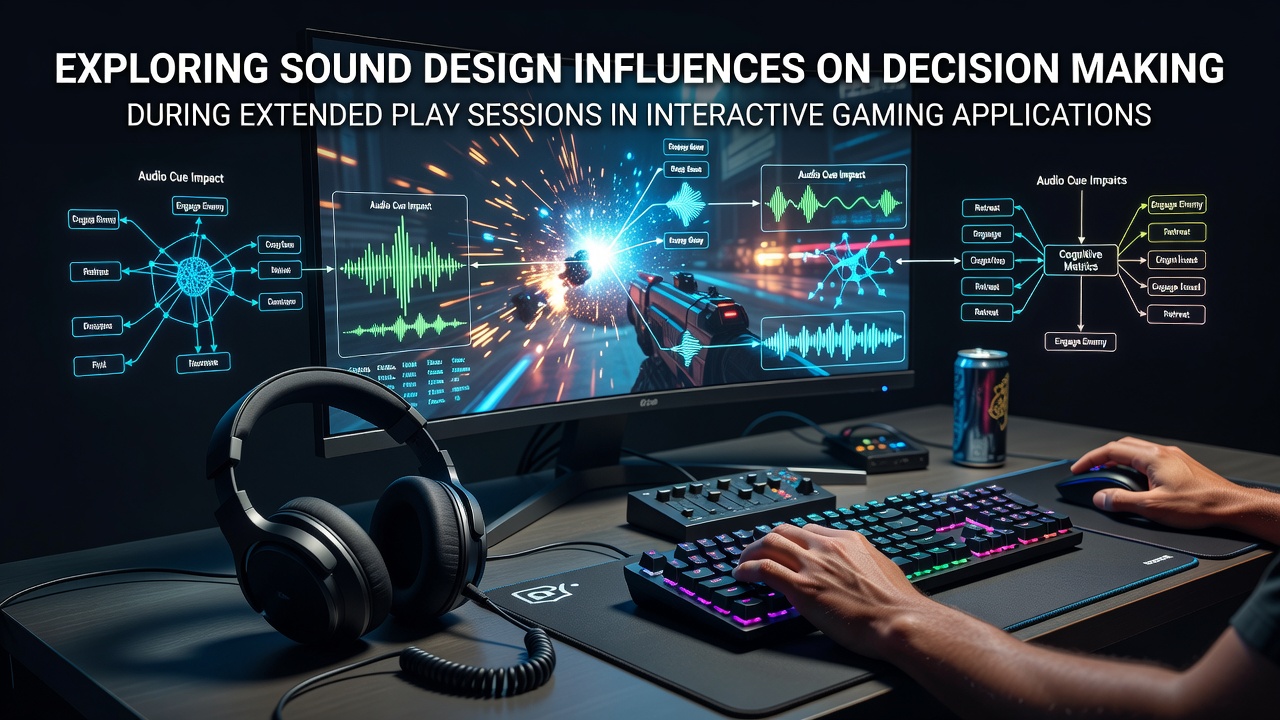
Exploring Sound Design Influences on Decision Making Processes During Extended Play Sessions in Interactive Gaming Applications
Sound design in interactive gaming applications shapes how players process information and select actions during sessions that stretch for hours at a time, with audio cues guiding attention toward specific mechanics and away from others in ways that studies have measured through controlled experiments and biometric tracking.
Researchers have documented that layered soundscapes, including dynamic music shifts and directional effects, alter response times and risk assessment patterns, particularly when fatigue sets in after the first ninety minutes of continuous engagement. Data from university laboratories show these changes occur because certain frequencies maintain arousal levels while others signal reward proximity or threat escalation.
Core Mechanisms of Audio Influence
Interactive applications employ adaptive audio systems that respond to player behavior in real time, and those systems draw on established principles from cognitive psychology to direct decision sequences. When background tracks increase in tempo during high-stakes moments, players allocate more resources to immediate choices rather than long-term planning, according to findings released by Stanford University labs in early 2026. The same research noted that spatial audio positioning helps users track multiple interface elements without visual overload, reducing errors in menu navigation during prolonged sessions.
Frequency modulation also plays a documented role. Lower bass frequencies tend to heighten perceived urgency, prompting faster selections, whereas higher melodic lines correlate with more deliberate evaluation periods. Observers note that developers calibrate these elements against session-length data collected from thousands of users, allowing the sound profile to evolve as play extends into the second or third hour.
Extended Session Dynamics and Cognitive Load
Extended play introduces measurable declines in attention that audio design can partially offset. In September 2026 the Australian Research Council published aggregated findings from multiple studios showing that carefully timed audio alerts restored decision accuracy by an average of 14 percent compared with silent control conditions. These alerts often take the form of subtle pitch changes rather than abrupt interruptions, preserving immersion while redirecting focus toward optimal choices.
Players who remain engaged beyond two hours exhibit different sensitivity thresholds, and sound designers adjust volume envelopes and harmonic density accordingly. One study tracked eye movement and heart-rate variability across four-hour sessions, revealing that consistent ambient loops reduced impulsive selections while intermittent reward chimes increased the likelihood of repeat actions. The data further indicated that abrupt silence following intense audio peaks created decision pauses that some applications deliberately insert to modulate pacing.
Application Across Platforms and Genres
Mobile and desktop implementations differ in how they deploy these techniques because hardware constraints affect audio fidelity and delivery. Portable devices rely more on haptic-accompanied sound cues to compensate for smaller speakers, and research indicates that synchronized vibration plus tone combinations improve retention of strategic information during extended mobile sessions. Desktop environments allow for richer multichannel mixes that support finer spatial positioning, which in turn influences pathfinding and resource-allocation decisions.
Cross-genre comparisons reveal consistent patterns. Role-playing titles use leitmotifs tied to character states to guide alliance or conflict choices, while strategy applications layer procedural sound generation that reflects shifting battlefield conditions. Both approaches have been shown to sustain engagement metrics without increasing self-reported fatigue when measured against visual-only baselines.
Measurement Methods and Recent Data
Contemporary studies combine EEG readings, clickstream logs, and post-session interviews to isolate sound effects from other variables. A 2026 report compiled by the Interactive Games and Entertainment Association drew on anonymized telemetry from multiple studios and found that titles incorporating adaptive scoring systems recorded steadier decision quality across session lengths compared with static audio implementations. The same dataset highlighted regional differences, with European and North American user cohorts displaying distinct responses to identical sound triggers, suggesting cultural factors interact with design choices.
Developers now incorporate these metrics into iterative testing cycles, running A/B variants that differ only in audio parameters. Results consistently demonstrate that small adjustments to decay times or harmonic intervals produce statistically significant shifts in average session duration and choice distribution, without requiring changes to core gameplay rules.
Conclusion
Sound design functions as an active variable in decision-making pathways within interactive gaming applications, with measurable effects that accumulate across extended play intervals. Ongoing research continues to refine understanding of how frequency, timing, and spatial characteristics interact with cognitive fatigue, providing developers with increasingly precise tools for shaping user experience through audio alone.